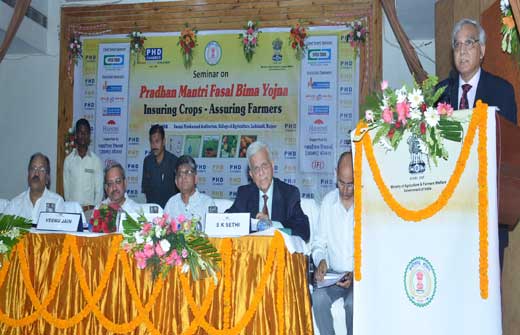
Seminar on Pradhan Mantri Fasal Bima Yojna 2016 – Insuring Crops, Assuring Farmers, Raipur (Chhattisgarh)

National Seminar on Pradhan Mantri Fasal Bima Yojna (Status and Need for Accessibility)

Agriculture has been a crucial sector in many developing countries across the world for its perceived ability to contribute significantly to achieve developmental objectives such as economic growth, employment generation, food security, poverty reduction, and environmental sustainability. Increasing the productive capacity of agriculture through higher productivity has been the main policy agenda in many developing economies.

Chhattisgarh, the 26th state of the Indian Union came into existence on November 1,2000. The total geographical area is around 137.90 lakh ha of which cultivable land area is 46.77 lakh ha. About 80 percent of the population in the state is engaged in agriculture and 43 percent of the entire arable land is under cultivation. Paddy is the principal crop and the central plains of Chhattisgarh are known as rice bowl of central India. Other major crops are coarse grains, wheat, maize, groundnut, pulses and oilseeds. The region is also suitable for growing mango, banana, guava & other fruits and a variety of vegetables with 44 percent of its area under forests it has one of the richest bio-diversity areas in the country.

The Govt. of India is dedicated to protect its farmers. This will not only help in sustaining livelihood of the farmers, but also increase the yield of crops grown. But there are several natural hindrances which prevent growth of crops. These are droughts, irregular rainfall, floods, etc. These natural calamities result in poor yield of crops. Also as the crops gets damaged midway production and yield is hampered. Another problem is when there is an over production of crops which happens sometimes, then the market demand falls and thus the farmers do not get good prices for their crops and suffer great losses. This leads to greater economic losses for farmers often leading to fatal consequences.

Insurance penetration amongst India’s farming community is abysmal and this is a known fact. Out of the gross cropped area of 195.26 million hectares in the country, only 42.82 million hectares or 22 per cent was covered under crop insurance in 2014. While the coverage was higher in some states — especially Rajasthan and also Chhattisgarh, Odisha, Bihar and Karnataka — it was hardly a tenth or less for the likes of Gujarat, West Bengal and Uttar Pradesh.

Low spread of agricultural insurance — one in every five hectares — isn’t the only issue. Equally important is the inadequacy of cover, in terms of the sum insured (SI) or the maximum amount that insurance would pay in the event of crop damage.

According to the Commission for Agricultural Costs and Prices (CACP), the average SI per hectare under the existing national agricultural insurance scheme was just Rs 18,464 (Rs 19,141 in kharif and Rs 16,927 in rabi) in 2013-14. This is way below the gross value of output (GVO) for most crops. For paddy the GVO on an all-India average yield of 36 quintals and minimum support price (MSP) of Rs 1,310/quintal in 2013-14 worked out to Rs 47,160 per hectare. If policy claims cannot cover even half of the value of produce when the crop suffers heavy damage, it only shows why farmers are not really interested in taking insurance protection. And it also explains the poor spread of crop insurance in a country that has experienced five full-fledged drought years (2002, 2004, 2009, 2014 and 2015) in this century alone.

Earlier, the insurance scheme which was functional was called the National Agriculture Insurance Scheme (NIAS), which was implemented in the year 1999, was implemented only in 14 states of India. The insurance settlements were handled by the insurance company namely Agriculture Insurance Company of India Ltd. (AIC). Under NIAS, the insurance premium rates were 1.5 % to 3.5 % of the total sum assured for food crops like pulses, oilseeds, cereals, etc. But for commercial crops like cotton and horticultural crops, the actuarial premium rates were charged.

To improve further and make the Scheme easier and more farmer friendly, a proposal on Modified National Agricultural Insurance Scheme (MNAIS) was prepared and was approved by Government of India for implementation on pilot basis in 50 districts from Rabi 2010-11 season. During the Five seasons of its implementation in 17 States, the MNAIS covered 45.80 lakh farmers for a premium of Rs.1,08,800 lakh against the claim of Rs.86,400 lakh until Rabi 2012-13. The total area insured was 46.79 lakh hectares during the same period.

With the objective to bring more farmers under the fold of Crop Insurance, a Pilot Weather Based Crop Insurance Scheme (WBCIS) was launched in 20 States in 2007. Apart from Agriculture Insurance Company of India, some private companies have also been allowed to implement the Scheme. The WBCIS is intended to provide insurance protection to the farmers against adverse weather incidences, such as deficit and excess rainfall, high or low temperature, humidity etc. The WBCIS was implemented in 18 States and 469.38 lakh farmers were covered for a premium of Rs.7,51,920 lakh against the claims of Rs. 52,860 lakh under the Scheme from 2007-08 to 2012-13.

According to reports in the past year 2015, there were 207 draught hit districts throughout the country where the farmers suffered great economic losses on crop cultivation. Also reports show that more than 300 districts were affected by irregular rainfall.

The Pradhan Mantri Fasal Bima Yojana (PMFBY) is effective from April 2016. The new scheme will come into force from the Kharif season starting in June this year. The scheme covers kharif, rabi crops as well as annual commercial and horticultural crops. For Kharif crops, the premium charged would be up to 2% of the sum insured. For Rabi crops, the premium would be up to 1.5% of the sum assured. For annual commercial and horticultural crops, premium would be 5 per cent.

Earlier only those farmers who have taken loans for their cultivation, were eligible for insurance of their crops. However as per the new scheme, all farmers are eligible for the new crop insurance scheme irrespective of the condition of taking loan or not. The insurance plan will be handled under a single insurance company, AIC and entire insurance process; right from joining of farmers to disbursement of claim is to be made electronically to make it a fraud free and effective scheme.

In view of these various concerns and complexities, PHD Chamber in Association with Insurance Foundation of India (IFI) are organizing a Seminar on “Pradhan Mantri Fasal Bima Yojna” on 9th June, 2016 from 10.30 am at Babylon International Raipur.

The main objectives of the seminar are to create awareness among all the related stake-holders and to deliberate on different aspects of the Pradhan Mantri Fasal Bima Yojana. Also to focus on all the regulations and technologies like use of remote sensing, smart phones and drones for quick estimation of the crop loss and making the claims process faster. The aim of the seminar is also to sensitize all the stake- holders on the adoption of Pradhan Mantri Fasal Bima Yojna and increase the insurance penetration.

The sessions will be joined by the senior officials from the Ministry of Financial Services, Government of India, Insurance Regulatory and Development Authority (IRDA), Agricultural Insurance Companies, Banks, Financial Institutions and representatives from the farmer community, Weather Forecasting experts.

ISSUES & WAY FORWARD

Farming is an inherently risky business and farmers face many types of risks. The two most important risks that farmers face are:

1. Yield Risk: Agriculture, in India is heavily dependent on monsoon, which at times is uncertain. Immemorial weather has been the major adversary that the farmers are not able to control.
2. Price Risk:
  • Price or market risk refers to uncertainty about the prices farmers will receive for commodities or the prices they must pay for inputs.
  • Revenue depends on production, prices, and interactions between the two. Prices received by farmers depend largely on global market conditions, while yields depend on localized factors, such as weather. The nature of price risk varies significantly from commodity to commodity.

TARGET GROUPS

  • Companies Handling Agricultural Insurance/ Fasal Bima Yojna
  • Small and Big Farmers/ Progressive Farmers
  • Contract Farmers/ Corporate Farmers
  • Financial Institutions/ Banks funding agriculture loans/ Micro Finance Companies
  • Weather Forecasting companies
  • Academic Faculty
  • Central and State government officials
  • Agri-based Technology Stake-holders
  • IRDA officials
  • Experts from sector of Agribusiness
  • Insurance Intermediaries/ Brokerage Firms

DELEGATE FEE

Free
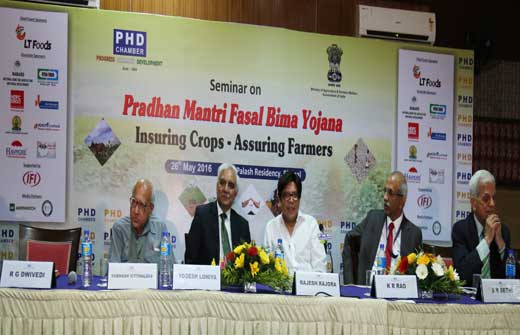
Seminar on Pradhan Mantri Fasal Bima Yojna 2016 – Insuring Crops, Assuring Farmers, Bhopal (Madhya Pradesh)

National Seminar on Pradhan Mantri Fasal Bima Yojna (Status and Need for Accessibility)

Agriculture has been a crucial sector in many developing countries across the world for its perceived ability to contribute significantly to achieve developmental objectives such as economic growth, employment generation, food security, poverty reduction, and environmental sustainability. Increasing the productive capacity of agriculture through higher productivity has been the main policy agenda in many developing economies.

Madhya Pradesh is located in Central India. The state is bound on the north by Uttar Pradesh, the east by Chhattisgarh, the south by Maharashtra and the west by Gujarat and Rajasthan. It is among the fastest growing states in the country. Madhya Pradesh is rich in natural resources – fuels, minerals, agriculture and biodiversity. There are 11 agro-climatic conditions and a variety of soils available in the state to support cultivation of a wide range of crops. Ideal soil and climatic conditions have made it a primary producer of coarse cereals, oilseeds and soybean in India

The major crops grown in Madhya Pradesh include paddy, wheat, maize and jowar among cereals, and gram, tur, urad and moong among pulses, while soybean, groundnut and mustard among oilseeds. Cash Crops like cotton and sugarcane are also grown in few districts of the state. Agriculture is the mainstay of State’s economy as 74.73 per cent of the people are rural. As much as 49 per cent of the land area is cultivable. The productivity of major crops like wheat, rice, pulses has also been good.

The Govt. of India is dedicated to protect its farmers. This will not only help in sustaining livelihood of the farmers, but also increase the yield of crops grown. But there are several natural hindrances which prevent growth of crops. These are droughts, irregular rainfall, floods, etc. These natural calamities result in poor yield of crops. Also as the crops gets damaged midway production and yield is hampered. Another problem is when there is an over production of crops which happens sometimes, then the market demand falls and thus the farmers do not get good prices for their crops and suffer great losses. This leads to greater economic losses for farmers often leading to fatal consequences.

Insurance penetration amongst India’s farming community is abysmal and this is a known fact. Out of the gross cropped area of 195.26 million hectares in the country, only 42.82 million hectares or 22 per cent was covered under crop insurance in 2014. While the coverage was higher in some states — especially Rajasthan and also Chhattisgarh, Odisha, Bihar and Karnataka — it was hardly a tenth or less for the likes of Gujarat, West Bengal and Uttar Pradesh.

Low spread of agricultural insurance — one in every five hectares — isn’t the only issue. Equally important is the inadequacy of cover, in terms of the sum insured (SI) or the maximum amount that insurance would pay in the event of crop damage.

According to the Commission for Agricultural Costs and Prices (CACP), the average SI per hectare under the existing national agricultural insurance scheme was just Rs 18,464 (Rs 19,141 in kharif and Rs 16,927 in rabi) in 2013-14. This is way below the gross value of output (GVO) for most crops. For paddy the GVO on an all-India average yield of 36 quintals and minimum support price (MSP) of Rs 1,310/quintal in 2013-14 worked out to Rs 47,160 per hectare. If policy claims cannot cover even half of the value of produce when the crop suffers heavy damage, it only shows why farmers are not really interested in taking insurance protection. And it also explains the poor spread of crop insurance in a country that has experienced five full-fledged drought years (2002, 2004, 2009, 2014 and 2015) in this century alone.

Earlier, the insurance scheme which was functional was called the National Agriculture Insurance Scheme (NIAS), which was implemented in the year 1999, was implemented only in 14 states of India. The insurance settlements were handled by the insurance company namely Agriculture Insurance Company of India Ltd. (AIC). Under NIAS, the insurance premium rates were 1.5 % to 3.5 % of the total sum assured for food crops like pulses, oilseeds, cereals, etc. But for commercial crops like cotton and horticultural crops, the actuarial premium rates were charged.

To improve further and make the Scheme easier and more farmer friendly, a proposal on Modified National Agricultural Insurance Scheme (MNAIS) was prepared and was approved by Government of India for implementation on pilot basis in 50 districts from Rabi 2010-11 season. During the Five seasons of its implementation in 17 States, the MNAIS covered 45.80 lakh farmers for a premium of Rs.1,08,800 lakh against the claim of Rs.86,400 lakh until Rabi 2012-13. The total area insured was 46.79 lakh hectares during the same period.

With the objective to bring more farmers under the fold of Crop Insurance, a Pilot Weather Based Crop Insurance Scheme (WBCIS) was launched in 20 States in 2007. Apart from Agriculture Insurance Company of India, some private companies have also been allowed to implement the Scheme. The WBCIS is intended to provide insurance protection to the farmers against adverse weather incidences, such as deficit and excess rainfall, high or low temperature, humidity etc. The WBCIS was implemented in 18 States and 469.38 lakh farmers were covered for a premium of Rs.7,51,920 lakh against the claims of Rs. 52,860 lakh under the Scheme from 2007-08 to 2012-13.

According to reports in the past year 2015, there were 207 draught hit districts throughout the country where the farmers suffered great economic losses on crop cultivation. Also reports show that more than 300 districts were affected by irregular rainfall.

To provide a better financial support to the farmers of the country Govt. of India has launched the The Pradhan Mantri Fasal Bima Yojana scheme in February 2016. A major boost to crop insurance has come via the Union budget, which has nearly doubled funding from Rs.2, 995 crore in 2015-16 (revised estimates) to Rs.5,501 crore in 2016-17.

The Pradhan Mantri Fasal Bima Yojana (PMFBY) is effective from April 2016. The new scheme will come into force from the Kharif season starting in June this year. The scheme covers kharif, rabi crops as well as annual commercial and horticultural crops. For Kharif crops, the premium charged would be up to 2% of the sum insured. For Rabi crops, the premium would be up to 1.5% of the sum assured. For annual commercial and horticultural crops, premium would be 5 per cent.

Earlier only those farmers who have taken loans for their cultivation, were eligible for insurance of their crops. However as per the new scheme, all farmers are eligible for the new crop insurance scheme irrespective of the condition of taking loan or not. The insurance plan will be handled under a single insurance company, AIC and entire insurance process; right from joining of farmers to disbursement of claim is to be made electronically to make it a fraud free and effective scheme.

In view of these various concerns and complexities, PHD Chamber of Commerce and Industry in Association with Insurance Foundation of India (IFI) are organizing a Seminar on “Pradhan Mantri Fasal Bima Yojna” on 26th May 2016 from 10.30 am at Hotel Palash Residency, Bhopal.

The main objectives of the seminar are to create awareness among all the related stake-holders and to deliberate on different aspects of the Pradhan Mantri Fasal Bima Yojana. Also to focus on all the regulations and technologies like use of remote sensing, smart phones and drones for quick estimation of the crop loss and making the claims process faster. The aim of the seminar is also to sensitize all the stake- holders on the adoption of Pradhan Mantri Fasal Bima Yojna and increase the insurance penetration.

The sessions will be joined by the senior officials from the Ministry of Financial Services, Government of India, Insurance Regulatory and Development Authority (IRDA), Agricultural Insurance Companies, Banks, Financial Institutions and representatives from the farmer community, Weather Forecasting experts.

ISSUES & WAY FORWARD

Farming is an inherently risky business and farmers face many types of risks. The two most important risks that farmers face are:

1. Yield Risk: Agriculture, in India is heavily dependent on monsoon, which at times is uncertain. Immemorial weather has been the major adversary that the farmers are not able to control.
2. Price Risk:
  • Price or market risk refers to uncertainty about the prices farmers will receive for commodities or the prices they must pay for inputs.
  • Revenue depends on production, prices, and interactions between the two. Prices received by farmers depend largely on global market conditions, while yields depend on localized factors, such as weather. The nature of price risk varies significantly from commodity to commodity.

TARGET GROUPS

  • Companies Handling Agricultural Insurance/ Fasal Bima Yojna
  • Small and Big Farmers/ Progressive Farmers
  • Contract Farmers/ Corporate Farmers
  • Financial Institutions/ Banks funding agriculture loans/ Micro Finance Companies
  • Weather Forecasting companies
  • Academic Faculty
  • Central and State government officials
  • Agri-based Technology Stake-holders
  • IRDA officials
  • Experts from sector of Agribusiness
  • Insurance Intermediaries/ Brokerage Firms

DELEGATE FEE

Free
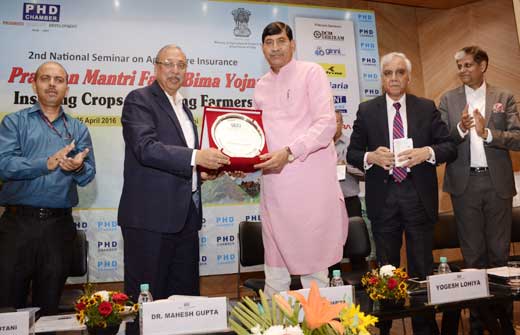
2nd National Seminar on Pradhan Mantri Fasal Bima Yojna 2016 – Insuring Crops, Assuring Farmers, New Delhi

National Seminar on Pradhan Mantri Fasal Bima Yojna (Status and Need for Accessibility)

Agriculture has been a crucial sector in many developing countries across the world for its perceived ability to contribute significantly to achieve developmental objectives such as economic growth, employment generation, food security, poverty reduction, and environmental sustainability. Increasing the productive capacity of agriculture through higher productivity has been the main policy agenda in many developing economies.

India is a land of farmers where the maximum proportion of rural population depends on agriculture. So the Govt. of India is dedicated to protect its farmers. This will not only help in sustaining livelihood of the farmers, but also increase the yield of crops grown. But there are several natural hindrances which prevent growth of crops. These are droughts, irregular rainfall, floods, etc. These natural calamities result in poor yield of crops. Also as the crops gets damaged midway production and yield is hampered. Another problem is when there is an over production of crops which happens sometimes, then the market demand falls and thus the farmers do not get good prices for their crops and suffer great losses. This leads to greater economic losses for farmers often leading to fatal consequences.

Insurance penetration amongst India’s farming community is abysmal and this is a known fact. Out of the gross cropped area of 195.26 million hectares in the country, only 42.82 million hectares or 22 per cent was covered under crop insurance in 2014. While the coverage was higher in some states — especially Rajasthan and also Chhattisgarh, Odisha, Bihar and Karnataka — it was hardly a tenth or less for the likes of Gujarat, West Bengal and Uttar Pradesh.

ALow spread of agricultural insurance — one in every five hectares — isn’t the only issue. Equally important is the inadequacy of cover, in terms of the sum insured (SI) or the maximum amount that insurance would pay in the event of crop damage.

According to the Commission for Agricultural Costs and Prices (CACP), the average SI per hectare under the existing national agricultural insurance scheme was just Rs 18,464 (Rs 19,141 in kharif and Rs 16,927 in rabi) in 2013-14. This is way below the gross value of output (GVO) for most crops. For paddy the GVO on an all-India average yield of 36 quintals and minimum support price (MSP) of Rs 1,310/quintal in 2013-14 worked out to Rs 47,160 per hectare. If policy claims cannot cover even half of the value of produce when the crop suffers heavy damage, it only shows why farmers are not really interested in taking insurance protection. And it also explains the poor spread of crop insurance in a country that has experienced five full-fledged drought years (2002, 2004, 2009, 2014 and 2015) in this century alone.

Earlier, the insurance scheme which was functional was called the National Agriculture Insurance Scheme (NIAS), which was implemented in the year 1999, was implemented only in 14 states of India. The insurance settlements were handled by the insurance company namely Agriculture Insurance Company of India Ltd. (AIC). Under NIAS, the insurance premium rates were 1.5 % to 3.5 % of the total sum assured for food crops like pulses, oilseeds, cereals, etc. But for commercial crops like cotton and horticultural crops, the actuarial premium rates were charged.

To improve further and make the Scheme easier and more farmer friendly, a proposal on Modified National Agricultural Insurance Scheme (MNAIS) was prepared and was approved by Government of India for implementation on pilot basis in 50 districts from Rabi 2010-11 season. During the Five seasons of its implementation in 17 States, the MNAIS covered 45.80 lakh farmers for a premium of Rs.1,08,800 lakh against the claim of Rs.86,400 lakh until Rabi 2012-13. The total area insured was 46.79 lakh hectares during the same period.

With the objective to bring more farmers under the fold of Crop Insurance, a Pilot Weather Based Crop Insurance Scheme (WBCIS) was launched in 20 States in 2007. Apart from Agriculture Insurance Company of India, some private companies have also been allowed to implement the Scheme. The WBCIS is intended to provide insurance protection to the farmers against adverse weather incidences, such as deficit and excess rainfall, high or low temperature, humidity etc. The WBCIS was implemented in 18 States and 469.38 lakh farmers were covered for a premium of Rs.7,51,920 lakh against the claims of Rs. 52,860 lakh under the Scheme from 2007-08 to 2012-13.

According to reports in the past year 2015, there were 207 draught hit districts throughout the country where the farmers suffered great economic losses on crop cultivation. Also reports show that more than 300 districts were affected by irregular rainfall.

To provide a better financial support to the farmers of the country Govt. of India has launched the The Pradhan Mantri Fasal Bima Yojana scheme in February 2016. A major boost to crop insurance has come via the Union budget, which has nearly doubled funding from Rs.2, 995 crore in 2015-16 (revised estimates) to Rs.5,501 crore in 2016-17.

The Pradhan Mantri Fasal Bima Yojana (PMFBY) is effective from April 2016. The new scheme will come into force from the Kharif season starting in June this year. The scheme covers kharif, rabi crops as well as annual commercial and horticultural crops. For Kharif crops, the premium charged would be up to 2% of the sum insured. For Rabi crops, the premium would be up to 1.5% of the sum assured. For annual commercial and horticultural crops, premium would be 5 per cent.

Earlier only those farmers who have taken loans for their cultivation, were eligible for insurance of their crops. However as per the new scheme, all farmers are eligible for the new crop insurance scheme irrespective of the condition of taking loan or not. The insurance plan will be handled under a single insurance company, AIC and entire insurance process; right from joining of farmers to disbursement of claim is to be made electronically to make it a fraud free and effective scheme. We understand 11 Insurance Companies will be handling the responsibility.

In view of these various concerns and complexities, PHD Chamber is organizing a National Seminar on “Pradhan Mantri Fasal Bima Yojna” on Tuesday, 26th April 2016 from 1:30 pm at PHD House, New Delhi.

The main objectives of the seminar are to create awareness among all the related stake-holders and to deliberate on different aspects of the Pradhan Mantri Fasal Bima Yojana. Also to focus on all the regulations and technologies like use of remote sensing, smart phones and drones for quick estimation of the crop loss and making the claims process faster. The aim of the seminar is also to sensitize all the stake- holders on the adoption of Pradhan Mantri Fasal Bima Yojna and increase the insurance penetration.

The sessions will be joined by the senior officials from the Ministry of Financial Services, Government of India, Insurance Regulatory and Development Authority (IRDA), Agricultural Insurance Companies, Banks, Financial Institutions and representatives from the farmer community, Weather Forecasting experts.

ISSUES & WAY FORWARD

Farming is an inherently risky business and farmers face many types of risks. The two most important risks that farmers face are:

1. Yield Risk: Agriculture, in India is heavily dependent on monsoon, which at times is uncertain. Immemorial weather has been the major adversary that the farmers are not able to control.
2. Price Risk:
  • Price or market risk refers to uncertainty about the prices farmers will receive for commodities or the prices they must pay for inputs.
  • Revenue depends on production, prices, and interactions between the two. Prices received by farmers depend largely on global market conditions, while yields depend on localized factors, such as weather. The nature of price risk varies significantly from commodity to commodity.

TARGET GROUPS

  • Companies Handling Agricultural Insurance/ Fasal Bima Yojna
  • Small and Big Farmers/ Progressive Farmers
  • Contract Farmers/ Corporate Farmers
  • Financial Institutions/ Banks funding agriculture loans/ Micro Finance Companies
  • Weather Forecasting companies
  • Academic Faculty
  • Central and State government officials
  • Agri-based Technology Stake-holders
  • IRDA officials
  • Experts from sector of Agribusiness
  • Insurance Intermediaries/ Brokerage Firms

DELEGATE FEE

Rs 1000 per delegate

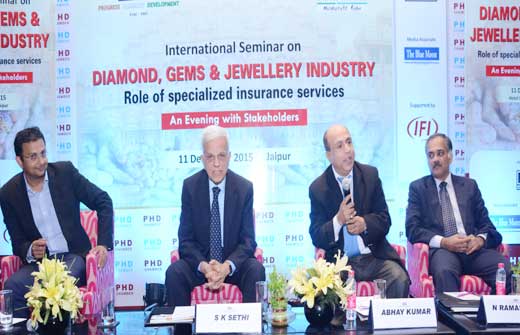
International Seminar on Diamond, Gems and Jewellery Industry- Role of Specialized Insurance Services 2015

Conference on Diamond, Gems and Jewellery Industry Insurance

The Gems and Jewellery sector in India plays a significant role in the Indian economy, contributing around 6-7 per cent of the country’s GDP. The domestic gems and jewellery industry had a market size of Rs 251,000 crore (US$ 40.45 billion) in 2013, and has the potential to grow to Rs 500,000–530,000 crore (US$ 80.59-85.43 billion) by 2018. The country’s gems and jewellery market could double in the next five years. Traditionally India is deemed to be the hub of the global jewellery market because of its low costs and availability of high-skilled labour. One of the fastest growing sectors, it is extremely export oriented and labour intensive. India’s gems and jewellery sector has been contributing in a big way to the country’s foreign exchange earnings (FEEs).

Insurance cover is provided as a specialized service by certain insurance companies in India to safeguard the business interests of stakeholders and ensure protection against theft, burglary, losses and the unforeseen.

Since huge money and investments are involved, the risk associated in this sector is of monumental proportions. The businesses of high value goods like jewellery or art can be devastated from a single incident evolving fire or robbery/theft etc. and can have a irrecoverable effect upon industry players those are not adequately protected. Insurance therefore provides all those who are trading in high value goods with the peace of mind needed to enable their business to operate effectively, safe in the knowledge that they are fully protected from such eventualities.

Additionally Insurance is extremely important for retailers, manufacturers or distributors handling high value items of diamonds, gems and jewellery. Uncovered losses can dramatically impact their overall business performance in long term. In addition to the usual risks covered for such high value items insurance plays a major role to safeguard stocks are in transit both domestic and global in nature.

Gems and Jewellery industry of India being an important contributor to the national GDP requires special focus for the exporters. Insurance need to play a major role for the export houses to cover risk of exchange and currency fluctuation in gold, gems and jewellery. Also government policies on controlling gold imports needs to be addressed.

Thus risk assessment and claims management is very important to facilitate the business health of stake holders. Supportive roles of banks dealing in the sector as well as specialized cargo movers and operator including airlines, valuers of diamond and gems are of vital importance. The re-insurer’s, surveyor’s perspective is also vital.

Against this backdrop and to deliberate on such issues PHD Chamber is organizing a International seminar on “Diamond, Gems and Jewellery Industry-role of specialized insurance services” on 11th December 2015 at Jaipur being a major hub of Diamond, Gems and Jewellery business of India.

All stake holders shall have a unique opportunity to hear the experts and interact for business safety growth and prosperity.

Eminent speakers with vast experience of insurance sector, re-insurer from overseas, businesses domains from India and overseas, experts from General Insurance Council, leading general insurance companies, Bankers, gems and jewellery valuer, insurance broking firms, surveyor, and representative from diamond, gems and jewellery industry would impart and share their knowledge and open to interact with participants.

TOPICS TO BE COVERED (The Seminar will feature and address the following issues)

  • Risk assessment – it’s necessity for diamond, gems and jewellery industry
  • Case Study & Presentation by IFFCO TOKIO General Insurance
  • Security Risks for DIAMOND, GEMS AND JEWELLERY INDUSTRY (International Perspective with Film)- By International Expert
  • Managing Claims In The Diamond, Gems and Jewellery Industry-
    1. Client’s Perspective
    2. Insurance Brokers Perspective
    3. Re-Insurer perspective (overseas perspective and best practices)
    4. Valuer’s Perspective
    5. Cargo Airlines/ Courier Perspective
    6. Bankers Perspective
    7. Surveyor’s Perspective
    8. Insurer’s Perspective
    9. Consultants Perspective

Objective of the seminar

  • To provide a platform for open house discussion between policy regulators, government and stakeholders
  • Role and importance of insurance in safeguarding business interest and protection against theft, burglary, losses and unforeseen threats (Riots/ Terrorism).
  • To focus on challenges in risk assessment and insurance claims management through case studies
  • To provide new innovative strategies through national and international best practices to enhance the business health of this niche market
  • Creating awareness on all the aspects of insurance and its necessities for high values Diamond, gems and jewellery industry
  • Describe the supportive role of insurers, re-insurers, bankers, valuers, cargo-airlines, surveyors, brokers in insuring high value diamond gems and jewellery industry so that this industry can grow to greater heights.
  • Role of insurance in exports, imports and stock in transit in diamond, gems and jewellery industry
  • Re-insurers roles in the sector with foreign country perspectives

TARGET GROUPS

  • Exporters, Retailers, Distributors, manufacturers, Dealers, Wholesalers of Diamond Gems and jewellery
  • Representatives of the state Government
  • Representatives of policy regulators and authorities
  • Country diplomats
  • International & National Insurance experts
  • Gemologists
  • Valuers
  • Institutes of the Sectors
  • Cargo Airlines/ Couriers
  • Bankers
  • Re-insurance Companies
  • Prominent Insurance Companies
  • Insurance Brokers/ Consultants
  • Surveyors, Loss Assessors
  • Major players related with diamond, gems and jewellery valuation and grading
  • Media Personnel
  • Members from Chambers of Commerce and Industry – Associations representing various segments of the insurance industry

DELEGATE FEE

Free

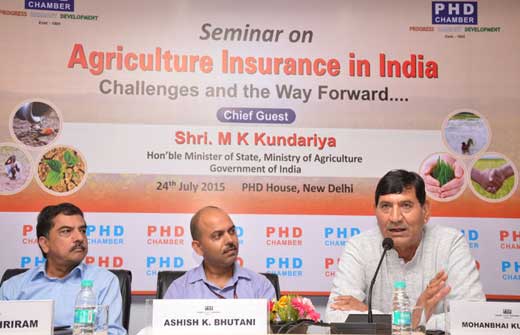
National Seminar on Agriculture Insurance in India 2015

Seminar on Agriculture Insurance in India (Status and Need for Accessibility)

Agriculture forms an indispensable part of Indian economy. Despite its importance, it is still dependent on vagaries of nature. Natural calamities and untimely nature process can have cataclysmic effects on the health of agriculture output and thus on farmers too.

Agriculture in India has gone through immense changes in the second half of the twentieth century. It is believed that insurance works best when it is varied and voluntary. To protect the farmers against losses suffered by them due to crop failure on account of natural calamities, Government of India has initiated a number of policies under the National Agricultural Insurance Scheme (NAIS). The latest insurance project, announced by the government, is the yet-to-be-launched National Crop Income Insurance Scheme (NCIIS), which guarantees income to the farmer during fluctuating prices (he pays a maximum of 20% of the loss), and during yield losses due to natural calamities, including drought or unseasonal rain (70-50% of loss caused). It brings all the other existing national insurance programmes under its purview.

Untimely rains and hailstorms in many parts of the country during March 2015 damaged the crops worth of cores of rupees. In Haryana alone, farmers witnessed their worst time ever in recent history where wheat crop in one lac acres suffered near 100% loss because of rain and hailstorm. In Maharashtra, unseasonal rains across the state have ravaged more than 50,000 hectares of rabi crop, mangoes and other horticultural produce. It is estimated that this might have destroyed crops worth about Rs 1,000 crore.

As per the study, it is estimated that only 19% of Indian farmers have ever had crop insurance. Among the rest, 24% believe that the facility is not available to them and 11% say that they couldn’t afford the premium. Majority of them are of the views that they are especially discouraged by delays in settlement of claims, which have often extended to a couple of years after the crop loss.

The National Sampling Survey Organisation (NSSO) 2013 also shows that only 4% of farmers, many of them high value croppers, have insurance. And yet, state expenditure on crop insurance premium was cut by 1.2% despite warnings of unpredictable rain due to climate change. High premium and compulsory clubbing of insurance with loans forcing farmers to pay premium and excluding non-borrowers are the most common reasons for this failure. Once crop losses occurred, claim-making was so bureaucratic and obstacle ridden that payments were delayed or not received. The method of calculating settlement eligibility is also rigid and unfair to the small holders, who need insurance most of all.

Threshold production is used as the basis for extent of crop loss. This means individual farmers take insurance, but their crop loss is not evaluated against expected yield for their own farm, but on threshold yield, which is the block’s average yield in the past five or three years. The farmer’s own loss is also not considered for the claim, but the average loss of the block. It is said that this doesn’t show understanding of rural landscape, rainfall patterns and heterogeneity in agricultural practices. These difficulties discouraged farmers from being insured, which led to low coverage, and therefore high premiums, making them unaffordable for those aware of insurance.

Crop insurance has also often been linked to bank credit. A farmer taking farm loans from a bank must purchase insurance. This protected banks from loss, not the farmer.

Crop insurance is required not only to provide financial security to the farmers but also income protection to the farmers by insuring production and market risks. The insured farmers were ensured minimum guaranteed income. It is necessary to protect the farmers from natural calamities, pests & diseases and ensure their credit eligibility for the next season. The farmers needed an insurance policy that could fulfil all expenses incurred on losses and the scheme should be long-term and completely transparent. Farmers are currently paid insurance cover only for some of the input cost whereas the actual loss is much more than the compensation awarded. Insurance cover all the food crops (cereals, millets and pulses), oilseeds and annual commercial/horticultural crops.

Insurance that provides financial compensation for production or revenue losses resulting from specified or multiple perils, such as hail, windstorm, fire, or flood. Most crop insurance pays for the loss of physical production or yield. Coverage is also often available for loss of the productive asset, such as trees in the case of fruit crops.

In view of the all these various concerns and complexities, PHD Chamber is organizing a seminar on Agriculture Insurance in India 24 July 2015 from 3:30 pm at PHD House, New Delhi. The main objectives of the seminar are to deliberate on different aspects of the crop insurance.

The sessions will be joined by the senior officials from the Ministry of Finance, Government of India, Insurance Regulatory and Development Authority (IRDA), Agricultural Insurance Companies, Banks, Financial Institutions, representatives from farmer community etc.

ISSUES & WAY FORWARD

Farming is an inherently risky business and farmers face many types of risks. The two most important risks that farmers face are:

1. Yield Risk: Agriculture, in India is heavily dependent on monsoon, which at times is uncertain. Immemorial weather has been the major adversary that the farmers are not able to control.
2. Price Risk:
  • Price or market risk refers to uncertainty about the prices farmers will receive for commodities or the prices they must pay for inputs.
  • Revenue depends on production, prices, and interactions between the two. Prices received by farmers depend largely on global market conditions, while yields depend on localized factors, such as weather. The nature of price risk varies significantly from commodity to commodity.

TARGET GROUPS

  • Agricultural Insurance Companies
  • Small and Big Farmers
  • Financial Institutions / Banks
  • Academic Faculty
  • Central and State government officials
  • Agricultural equipment manufacturing companies
  • Fertilizer companies

DELEGATE FEE

Free

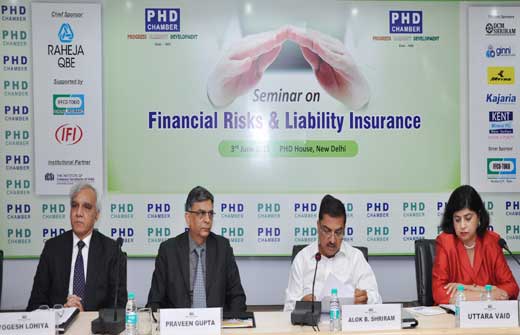
Seminar on Financial Risks & Liability Insurance 2015

WHY SPECIALIZED SEMINAR ON FINANCIAL RISKS & LIABILITY INSURANCE ?

In the last 20 years profile of Indian economy has changed and we are seeing large growth in Servicing Industry as a result it has become a significant player in Indian economy. IT, e commerce, exports, project exports, acquisition of companies in foreign countries by Indian Companies or inflow of PE, VC Funding from foreign investors in Indian companies especially in Pharma, IT and e commerce is resulting in changes in Board Room. These changes have resulted in need for Insurance Policies as a part of Shareholders agreement being signed between Indian Promoters & Strategic Investors or PE/VC funds.

We come across need for buying of D & OE insurance Policy or 3rd party liability insurance policy as a requirement clearly recorded in shareholders’ agreement. Now a day’s 3rd party liability insurance policy is required by RWA or owner of the building for getting licence from Government authorities in Haryana for issuing licence for operating lifts in Multi story towers.

Political turmoil in any part of the world can ruin an exporter or Project exporter in the event of turmoil caused by infighting, civil war or border conflict and consequently money getting blocked in hundreds of Crores and that too for a long period. Syria, Iraq, Afghanistan Libya are few examples before us.

Credit Insurance within India is also becoming a necessity with a view to avoid bad debt. With these facts in mind we have decided to organize this thought provoking session.

WHO SHOULD ATTEND THE PROGRAMME?

This is a good opportunity for:

  1. Industrialists
  2. Owners of Business houses
  3. Directors/ Independent Directors
  4. CEO’s
  5. CFO’s
  6. HR Managers
  7. Company Secretaries
  8. Specialists handling underwriting/ business development/ claims in Insurer Firms
  9. Corporate Lawyers guiding business houses on drafting of agreements.
  10. Insurance Managers
  11. Insurance Brokerage Firms
  12. Insurance Institutes

This will be an opportunity to you to upgrade yourselves to handle changing requirements in the economy.

WHAT YOU CAN EXPECT FROM THE PROGRAMME?

Multiple laws, Regulations, Factors, Internal policies (e.g. HR policy) are guiding your business in complex & continuously changing business environment. Sitting in the Board of Directors meeting without understanding these requirements and need for Insurance policies is the minimum requirement from you to make a value addition in the Board Room. In short you will be adding knowledge in 4 hours for which you may need 4o hours of study on Internet.

SOME KEY TAKE AWAYS FOR VARIOUS STAKEHOLDERS WILL BE

  • Understanding why these comparatively new type of insurance policies are needed?
  • Can these insurance policies increase the market capitalization of a listed company or valuation of the closely held company undergoing due diligence for % divestment to Strategic Partner or a VC fund?
  • Why knowledge of these insurance policies are a must for promoter directors/ Executive Directors or even Independent Directors, where some of them might have given personal guarantee at the time of disbursement of loan.
  • Clauses pertaining to Financial Risks & Liability Insurance which you should look for when signing Share holder agreement with JV partner or VC Fund?

TOPICS TO BE COVERED

  • Importance of Project Export Credit Insurance in growing Project Export Market of India (with focus on claims history) and how stuck up payments have ruined the Indian companies?
  • Credit Insurance within India – growing importance due to sudden grounding of some airlines
  • Liability Insurance
  • D & OE/ Errors & Omissions: Need of IT Industry, bpo, kpo or eCommerce supported by case studies within India and abroad.
  • Human resource aspects & correlation with D&OE policy

DELEGATE FEE

Participation fee: Rs. 3000/- per individual participant.
Group participation fee (team of 5 persons): Rs.2500/- each.
Group participation fee (team of 10 persons and above): Rs.2000/- each.

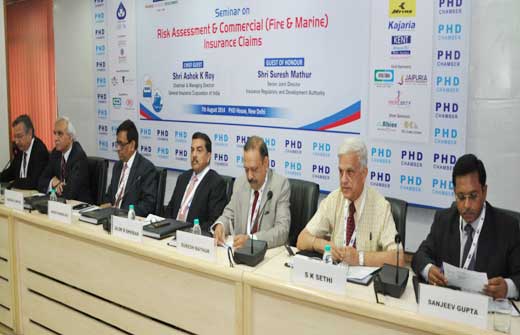
Seminar on Risk Assessment and Commercial (Fire & Marine) Insurance Claims 2014

Why need for Specialized Industry Focused Training Programme on Project Insurance?

Indian Economy is growing at a fast pace and large amount is being invested in the following projects:

  • Infrastructure
  • Ports/ Airports
  • Highways
  • Roadways
  • Metro/ Rapid Metro
  • High Rise Buildings
  • 300 Smart Cities

Country is also focusing on “Make in India” and large amount is being invested in setting up of various manufacturing projects:

  • Defence Infrastructure
  • Petro Chemicals
  • Power Generation
  • Food Processing/ Cold Chain Supply Line
  • FMCG
  • Electronics/ Electrical Manufacturing

All these projects need Project Insurance Policies where all aspects of Risk are covered and hence we find that there is need for specialized training Programme on:

  • Contractors All Risks (CAR) Insurance Policy
  • Erection All Risks (EAR) Insurance Policy
  • Advance Loss of Profit Policy
  • Marine Loss of Profit Policy

All major projects and investments present great opportunities, but also have many unforeseen risks as well. The management of risk in construction projects involves both the allocation of risk under the project contracts and the management of those risks through insurance. The ability to recognize and overcome risks is crucial to the success or failure of any project.

Investors, lenders, contractors and implementors of projects are exposed to a wide range of risks which may:

  • Impact the asset base
  • Interrupt the revenue stream
  • Affect repayments to lenders and investors

The potential risks can be divided into following three groups:

  • Physical Assets Protection
  • Design Engineering Risks
  • Management Liability
  • Financial Market and Economic reforms

Project insurance should cover ‘All-risks’ of loss or damage to the permanent and temporary works comprising the contract, including the materials, and all things used for or intended for incorporation within the contract, throughout various phases of the construction/ erection, including testing.

Objectives of the Training Programme:

This training programme will give an opportunity to participants to interact with faculty, who have vast experience of dealing with products which form part of Project Insurance. Participants will be able to learn about the experience of various organizations.

This training programme is very practical in nature and is Case Study Based to provide a practical understanding of various products which form part of Project Insurance. The aim is to discuss and come out with solutions for issues faced during purchase of these products, lodging and settlement of claims associated with the same.

Every session will be followed by Questions/ Answers so that high level of clarity is achieved.

  • Contractors All Risks (CAR) Insurance Policy
  • Erection All Risks (EAR) Insurance Policy
  • Advance Loss of Profit Policy
  • Marine Loss of Profit Policy
  • Risk Management in Infrastructure Projects
  • Underwriting Challenges in Infrastructure Projects.
  • Claims Challenges in Infrastructure Projects
  • Contractual obligations
  • Contractual risk flows
  • Competitive pressures
  • Technological Development
  • Regulatory Requirements
  • Claims Procedure – how to expedite it by keeping in mind the Procedural Aspects of Insurers. This will be supported with Case Studies.

Who Should Attend the Training Programme (Target Participants)?

This is a good opportunity for:

  • Risk Managers/ Mangers handling purchase of insurance policies and lodging of claims on behalf of:
    1. Corporates
    2. Implementors of large Projects
    3. Manufacturing firms
    4. Large Construction Companies
    5. EPC Contractors
    6. Large Real Estate developers
  • Decision makers in the large infrastructure companies
  • Middle/ Senior level managers in Insurance Companies
  • Surveyors & Loss Assessors
  • Managers/ Executives of Insurance Brokerage Firms – Business Development/ Underwriter/ Claims Department.
  • Consulting firms providing services to Infrastructure & large projects.
  • Academic – Faculty members/ students specializing in General Insurance

What you can expect from the Training Programme?

This training programme on Project Insurance will provide the participants with

  • Empowering the customers of project insurance in the infrastructure industry
  • Providing an insurer-insured interface
  • Improving Project Insurance knowledge and professional level

Traning/ Delegate Fee:

Participation fee (Includes Training, Study Materials & Lunch)

  • Individual participant fee: Rs. 3500/
  • Group participation fee (team of 5 persons and above): Rs.3250/-each.
  • Group participation fee (team of 10 persons and above): Rs.3000/-each.

Note: Prior registration/ confirmation are requested to attend this Training Programme, so that Certificates/ Logistics/ Study Material & Lunch can be arranged accordingly.